

💼 How to Answer: “Why Do You Want to Leave Your Job?”
Few interview questions carry as much weight—or as much anxiety—as the query about why you left your last role or why you are looking to leave your current one. 😰
Hiring managers ask this question to gauge your motivation, your professionalism, and your cultural fit. A strong answer is honest, concise, and forward-looking. It briefly explains the change, avoids criticizing past employers, and pivots quickly to what you are seeking in your next opportunity. 🎯
To help you navigate this conversation, we have broken down the most common reasons for leaving a job into four primary categories:
- 🧑💼 The Manager – Nearly 50% of employees leave due to their direct supervisor.
- 💰 The Money – Compensation is the second most common driver of turnover.
- 🏢 The Company – Restructurings, layoffs, and instability force many to look elsewhere.
- 🧭 The Role & Logistics – Stagnation, burnout, and changing location needs.
While you should never cite “bad management” or “low pay” as your primary reason in an interview (it sounds like a complaint, not a career move), you can reframe these realities professionally. Here is how to answer, no matter your situation. 👇
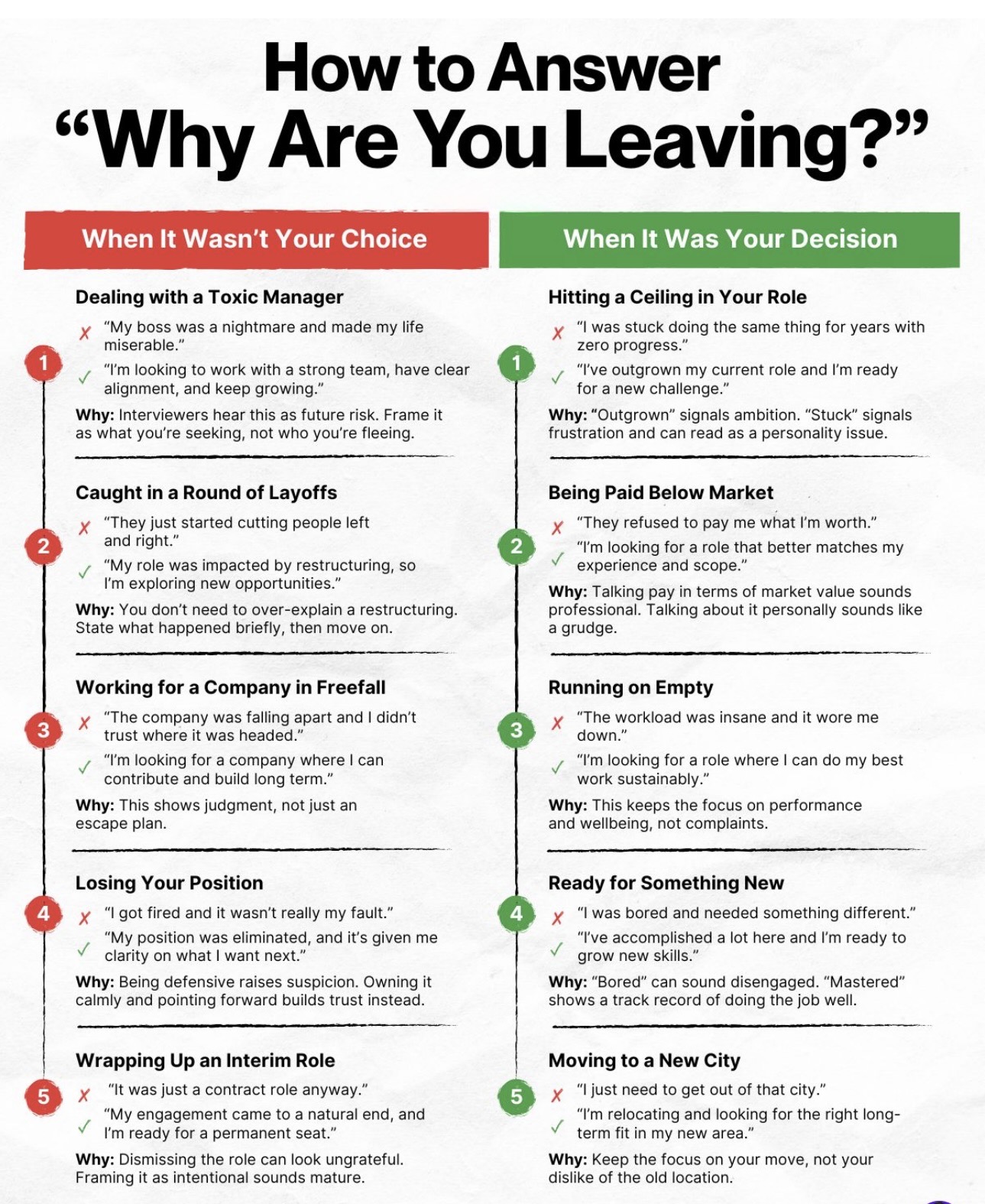
🧑💼 Category 1: The Manager (Without Saying “My Boss Was Toxic”)
When your manager made your daily life difficult, the goal is to talk about the future you want, not the past you are escaping.
- What you want to say:
“My boss was a nightmare and made my life miserable.” 😤 - What you should say:
“I’m looking to work with a strong, collaborative team where there is clear alignment on goals and room for professional growth.” 🤝 - Why it works:
Interviewers hear complaints about bosses as a “future risk” (will you complain about them next?). By framing it as what you are actively seeking, you sound optimistic and self-aware, not bitter. 🌟
💰 Category 2: The Money (Without Sounding Greedy)
Compensation is a valid reason to move, but leading with it can make you appear transactional. Instead, tie it to your value.
- What you want to say:
“They refused to pay me what I’m worth.” 💸 - What you should say:
“I’m looking for a role with a scope that better matches my experience and the impact I’m ready to make.” 📈 - Why it works:
Talking about pay in terms of “market value” and “scope of responsibility” sounds professional and strategic. Talking about it personally sounds like a grudge. 🧠
🏢 Category 3: The Company (Layoffs, Mergers, and Instability)
If the company was in freefall or your position was eliminated, you have the easiest path to a neutral answer.
- What you want to say:
“The company was falling apart, and they just started cutting people left and right.” ⚠️ - What you should say:
“My role was impacted by a restructuring, which has given me clarity on what I want next. I’m now looking for a stable company where I can contribute and build a long-term career.” 🏗️ - Why it works:
You acknowledge the reality of the layoff without over-explaining. You then pivot immediately to your judgment and desire for stability, which signals maturity and resilience. 💪
🧭 Category 4: The Role & Logistics (Stagnation, Burnout, and Relocation)
This is the most common category for voluntary departures. The key is to sound ambitious, not frustrated.
📉 Hitting a Ceiling (Stagnation)
- What you want to say:
“I was stuck doing the same thing for years with zero progress.” 🛑 - What you should say:
“I’ve outgrown my current role and I’m ready for a new challenge that pushes my skills further.” 🚀 - Why it works:
“Outgrown” signals ambition. “Stuck” signals frustration and can read as a personality issue. 🌱
😩 Running on Empty (Burnout)
- What you want to say:
“The workload was insane and it wore me down.” 🔥 - What you should say:
“I’m looking for a role where I can do my best work sustainably and maintain a healthy work-life balance.” ⚖️ - Why it works:
This keeps the focus on performance and wellbeing, rather than sounding like a complaint about the previous employer. 🌿
🎯 Ready for Something New (Boredom)
- What you want to say:
“I was bored and needed something different.” 😴 - What you should say:
“I’ve accomplished a lot in my current role and I’m ready to develop new skills and tackle different challenges.” 🧩 - Why it works:
“Bored” sounds disengaged. “Ready to grow” shows you have a track record of success and an appetite for more. 📚
📍 Moving or Changing Locations
- What you want to say:
“I just need to get out of that city / I hate commuting.” 🚗💨 - What you should say:
“I’m relocating to [New City] / seeking a remote setup to better align with my lifestyle, and I’m looking for the right long-term fit in this new arrangement.” 🏡 - Why it works:
Keep the focus on your forward-looking plans, not your dislike of the old location or commute. 🗺️
🏁 The Final Takeaway
No matter which category you fall into, the formula remains the same:
Acknowledge the change briefly + State what you learned + Pivot to what you want next. ✅
By mastering this pivot, you transform a potentially awkward question into a powerful statement about your career aspirations—and prove that you are a professional who moves toward opportunities, not just away from problems. 🌈
#JobInterviewTips #CareerAdvice #WhyAreYouLeaving #InterviewPreparation #CareerGrowth #JobSearchHelp #ProfessionalDevelopment #InterviewAnswers #CareerPivot #WorkplaceWisdom #Directitrecruuiting #CareerCoach #JobHunt #InterviewSuccess #CareerStrategy #IT #career #job #jobs
Career, Interview Questions, Interview Tips, IT Jobs, job, Job Interview, Job Search, jobs